Saturday, September 23, 2006

RETAIL-IATION


WAL-MART WARNS STUDIOS OVER
DVD DOWNLOADS

Apparently, Wally World is feeling the heat from the digital age and worried about sales of those blobs of plastic we lovingly call DVD's. From a story by Tim Arango in the New York Post (click on this entries title for the full story):

Several weeks ago, in the midst of rumors that Apple was close to announcing a deal with Disney, Wal-Mart's David Porter - the executive responsible for stocking the retailer's shelves with DVDs and CDs and whose influence is so immense in Tinseltown that he's been named to Premiere magazine's annual power list - made the rounds of Hollywood studios.

His message, according to a studio exec involved in the discussions: that there would be "serious ramifications" if the studios hopped in bed with Apple.

"They threatened to hurt us in terms of buying less products," said this person.

"Serious Ramifications"? I'm pretty sure those are the exact words used by the Mob's lawyer in The Godfather while talking with a Senator about who would, or wouldn't give them access to the casino's of Las Vegas. Movies, imitating life, imitating movies. Spooky.

With $5 Billion (yep, a B) in DVD sales in Q4 alone, Walmart is by far the largest distributor of movies in the US. This gives them some pretty heavy cred in Hollywood. It's similar to how Blockbuster Video used to help the studios 'decide' what movies would be funded (and not). If you do a historical evaluation of the types of movies sold from the time "BB" (before Blockbuster) and after, you'll see a large number of 'formula' movies spike up as Blockbuster became the McDonalds of Movie distribution.

Now, with DVD players costing $39, it's about retail, and who's the king of retail in this country? Walmart, of course. And so the power curve shifts.

Walmart cuts the price of current DVD's, and makes most of it's profit from DVD's on the 'inventory'. The other 50,000 title's it carries in it's DVD section, where the price is generally higher. But it's limited by the amount of shelf space each store can carry.

Walmart, to date, hasn't been able to translates it's strengths in the logistics of retail overly well to the online world. Largely due to fact that the barriers to entry online are a little less than the cost of building 4000 Walmart stores to blanket the country (does Longmont REALLY need 2 Walmarts? One one on each end of town?).

Our own experience with ClickCaster bares this out. Although nothing close to the potential scale of Apple, we've recently cut a deal with the folks over at Gameznflix (www.gameznflix.com) who have access to a library of thousands of (mostly older) video products that include things like pre WWII cartoons, Hitchcock movies and other stuff that you just don't find on at Walmart (or iTunes). Classic long tail stuff. Their cost to put this up? The price of labor to upload and a broadband connection. They get paid everytime someone downloads a copy though, and the cost of building a 100,000 SF supercenter never enters the equation.

If Apple (and companies like GamezNflix, using technology from companies like ClickCaster) can effectively carry catalogs of digital content that, once encoded and uploaded to a server, have close to a zero distribution cost, the games changed forever. Just look at the music industry for a preview.

How can Walmart compete with this?
  1. It could jump on the online bandwagon. Build it's own movie distribution service on the web.
  2. It could expand it's physical DVD distribution by making their DVD sections bigger
  3. It can threaten the content creators to 'not work with the new guys'
With #1, that puts Walmart on the internet with digital movie distribution. Goodness. More competitors means better distribution/choice and better pricing for consumers. But how to compete? There's no differentiation between Walmart, Apple, Amazon or GameZnFlix on the internet (remember the old New Yorker comic: "on the internet, no one knows your a dog"?). The billions spent to create barriers of entry via their brick and mortar stores just doesn't matter in this world.

With #2, they'd up their numbers, but the only way to really carry every movie ever made would mean converting entire Walmart supermarts to massive DVD stores. Even then, they'd miss a few of the more obscure titles (companies like ClickCaster are already making it possible for someone to make an indie movie, upload it and sell it online at zero cost to the movie maker until the movie sells when a cut is then taken by the distributor.. but not before). And the cost of managing the physical inventory would make them uncompetitive with the near zero cost of digital distribution.

With #3, well, I'd expect the DOJ to get involved if they actually DID anything to retaliate against the studios (or any content providers). You can't go around saying "use the new guy and I'll break your legs". I know Walmart's similar to the Mafia in many ways, but this would be just a little too blatant, even for our business friendly culture.

So what's going to happen?

It'll take 5 years, maybe more, but with broadband more ubiquitous then dialup, and computers more than powerful enough to run people's media lives (including their TV's), the power base will shift.

The movie industry can get in bed, fast, with the digital distribution guys, or it can end up like the recording industry, losing double digits in sales year over year and suing their customers.

The User Generated Content effect:

There will always be demand for high quality, highly produced movies. But it'll drop off as more and more interesting content from the rest of us becomes available.

When I can buy an HDTV quality video camera for $600, with a built in 40 gig hard disk, I can make a movie. Will it suck? Yea, that's likely. Will all of them suck? Nope. We see it now in the music world. You can buy a studio quality mixer and mics for $300. Software, $100. Computer, $500. $900 (new) and you've got a real recording studio. And don't tell me that the quality of music has gone in the toilet. What we're seeing is really good and some great musicians are now able to create their own 'albums' (whatever that means nowadays) and distribute them through multiple channels (iTunes, MySpace, Raposdy, and a dozen others) that were never available to them before. They are very effectively bypassing the recording studios. What's different here between the movie and recording industries? I'm not seeing much difference at all. The only real difference is the movie industry has A CHANCE to do it right. Will they? I sincerely hope so.. but I have my doubts.

And Walmart, in the end, becomes the place you can buy the fewer and fewer big budget movies made and distributed as overpriced blobs of plastic for your $39 walmart DVD player.

Sunday, September 17, 2006

Was the 2004 Election Stolen?


Was the 2004 Election Stolen?
Republicans prevented more than 350,000 voters in Ohio from casting ballots or having their votes counted -- enough to have put John Kerry in the White House.

ROBERT F. KENNEDY JR.


GREAT article in the Rolling Stone on how Bush did, indeed, rig the 2004 election. Lots of pretty compelling arguments and statistical analysis that shows that's what happened (Bush being elected) was, pretty much, impossible. I love the title. That question mark at the end is one of the tricks networks like Fox use to make accusations without having to support claims. Kind of like saying "Could your mother be a whore?" (Thanks to Jon Stewart for this example). An excerpt from the article:
But what is most anomalous about the irregularities in 2004 was their decidedly partisan bent: Almost without exception they hurt John Kerry and benefited George Bush. After carefully examining the evidence, I've become convinced that the president's party mounted a massive, coordinated campaign to subvert the will of the people in 2004. Across the country, Republican election officials and party stalwarts employed a wide range of illegal and unethical tactics to fix the election.
So what you say? Nothing we can do about it now. True. But you can effect the next round. Get your butt to the polls this November and vote. Plain and simple. Enough people are aware of this that it's unlikely they'll be able to pull it off again (and since it's not a presidential election and alot harder to coordinate since it's so distributed, it's unlikely they'll try, or so we can hope).

Read the article. It's intelligently written, full of facts and level headed. Every American should give it a good read and spend a few contemplative moments thinking about what it means, and what they need to do to make sure it doesn't happen this way again.

Click on the title of this posting to go to the article, or use this:

http://www.rollingstone.com/news/story/10432334/was_the_2004_election_stolen

The US National Debt

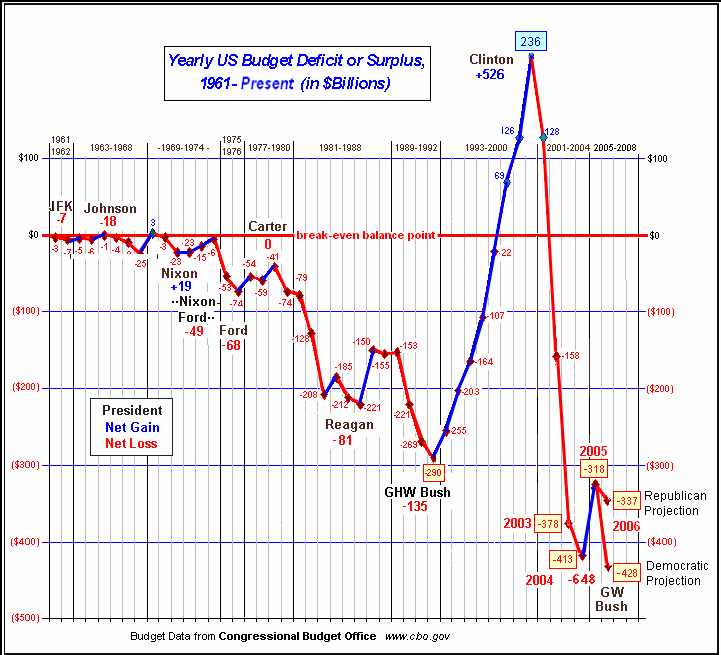
I've got to wonder if anyone's really paying attention to what our government is doing to the national debt. And we're not talking a slow decades long problem. Just a few years ago, I'm talking 3 years, we had a 500 billion plus surplus.

Today? Well let the US National Debt clock tell the story:

U.S. NATIONAL DEBT CLOCK

The Outstanding Public Debt as of 17 Sep 2006 at 07:36:58 PM GMT is:

$ 8 , 5 3 2 , 5 4 3 , 1 8 6 , 3 3 3 . 7 1

The estimated population of the United States is 299,521,300
so each citizen's share of this debt is $28,487.27.

The National Debt has continued to increase an average of
$1.70 billion per day since September 30, 2005.


Above is a graph that gives you a visual representation over time.

Now, I know that the Republicans have a semi-unstated goal of bankrupting the federal government in order to lessen the influence of government in our lives. But I've got to ask is this is something that works.

I'm technically an independent. I don't really follow a party line. But I know one thing: If I ran my personal life, or my business, remotely close to how the current republican administration is running our country, I'd be both personally bankrupt and out of business.

America's heading toward being the shortest lived 'world power' in history. And I'd say, from a purely fiscal perspective, this has got to be an intentional policy on the part of the Republicans (who are TOTALLY in control right now with the white house, the congress, the senate AND the US Supreme court, with the recent placement of right leaning justices, all in their power.)

So, I've got to lay this (and many many other problems) squarely at the doorstep of the Republicans.

When Clinton handed over the government to the Republicans, we had a rapidly expanding economy, low interest rates, rising home values, full employment, respect among the world powers and world wide (relative) peace.

What do we have today?

Monday, August 28, 2006

My First DECLINED LinkedIn invitation!

I am crushed.

An old collegue from Apple Computer (who, albiet, I didn't know well, I just remembered her name) TURNED DOWN my LinkedIn invitation!

A first! I'm sad. And a bit happy. I'm glad to see that there's at least some degree of filtering going on. I know I've said no to alot of the guys just looking to add names to their list, but not all of them (LinkIn 'notches' on the belt... so to speak.. God, when I think of it, I feel so... used....sigh).

LinkedIn

Invitation Declined

Linda XXXX (formerly XXXX) declined your invitation to connect, because Linda doesn't know you well enough to represent your interests when forwarding requests or facilitating contacts.

And added these comments:

Sorry, I'm keeping my network restricted to those I know very well.

You can view your connections here, or by pasting the following link into your browser:

http://www.linkedin.com/xxxxx

Thank you for using LinkedIn.

--The LinkedIn Team
http://www.linkedin.com/

Wednesday, August 23, 2006

Bob Dylan... Luddite!


Bob Dylans a Luddite!

What's interesting about this is he's been on the cutting edge of music for so long, and is obviously using digital technology in the studio.

I wonder if he's releasing the new album on vinyl.

Who'd a thought? From Wired:

Bob Dylan says the quality of modern recordings is "atrocious," and even the songs on his new album sounded much better in the studio than on disc.

"I don't know anybody who's made a record that sounds decent in the past 20 years, really," the 65-year-old rocker said in an interview with Rolling Stone magazine.

Dylan, who released eight studio albums in the past two decades, returns with his first recording in five years, Modern Times, next Tuesday.

Noting the music industry's complaints that illegal downloading means people are getting their music for free, he said, "Well, why not? It ain't worth nothing anyway."

"You listen to these modern records, they're atrocious, they have sound all over them," he added. "There's no definition of nothing, no vocal, no nothing, just like ... static."

Dylan said he does his best to fight technology, but it's a losing battle.

"Even these songs probably sounded 10 times better in the studio when we recorded 'em. CDs are small. There's no stature to it."


Guess it's ok to pirate anything he does that's been digitized eh?


Monday, August 21, 2006

Verizon's now making up fee's, literally


Anyone who thinks the phone company will do the right thing and 'pass on savings to the consumer' just got a nice screw you from Verizon.

Apparently, the government stopped requiring Verizon charge a universal fee to help cover the cost of phone service coverage in rural areas on DSL lines. From $1.20 to $2.80 a month. Your bill should drop by that much now, right?

Not so much. The unvarnished word directly from Verizon:
"Effective August 26, Verizon will charge a Supplier Surcharge for all DSL customers. The surcharge helps offset costs we incur from our network supplier. The Supplier Surcharge will be $1.20/month for 768Kbps service customers and $2.70/month for higher DSL speeds.

Verizon Online will cease charging an FUSF recovery fee, beginning August 14, 2006. The impact of the elimination of the FUSF fee is for DSL customers up to 768Kbps, fee eliminated is $1.25.month; for DSL customers of up to 1.5Mbps and 3Mbps services, the fee eliminated is $2.83/month. On balance your total bill will remain about the same as it has been or slightly lower."
What happened here? They instituted some made up cost they have been 'absorbing for some time' to match the drop in price. They also, of course, neglected to detail what this extra cost was (other than: we're losing money in our landline phone business.. doh.. you and the rest of the world).

I've got no beef with Verizon making money. Really. But when they could pass on the savings of a government tax that is no more, and instead just tack it onto your bill as some random fee to keep the money you've been 'trained' to pay out already, I have to ask: what else are they tacking on and charging for that has no value other than to add pure profit?

These guys operate as near monopolies. I'm no fan of government regulations (being a libertarian hippie and all), but some guys just need watching.

Verizon is one of these guys.

They've effectively evoked a rate hike of hundreds of millions of dollars on their users, without a single regulator getting a look at it (or, it seems, caring much about it).

This is from today's Wall Street Journal (and even they seem to be looking at it a big cockeyed):

Verizon Adds New DSL Surcharge

By AMY SCHATZ and DIONNE SEARCEY
August 21, 2006 4:09 p.m.

For Verizon Communications Inc.'s Internet customers, monthly bills won't be dropping after all.

Last year, the government changed the rules so DSL subscribers would no longer have to pay into a federal fund which subsidizes phone services in rural areas and for low-income consumers. That promised to shave a dollar or two off a typical DSL Internet bill -- $1.25 a month for Verizon's slower DSL service and $2.834 a month for its faster service.

But Verizon recently emailed subscribers, announcing that it will drop the universal service surcharge as of Aug. 14 and impose a new "supplier surcharge" beginning August 26. The new fee -- $1.20 a month for slower service customers and $2.70 a month for faster ones -- is almost exactly what consumers would have saved with the government's change. Essentially customers' bills won't fall at all.

It appears that Verizon is essentially pocketing the money that consumers would have gotten back, although the company disputes that notion. It says it will eventually impose the fee on all of its six million or so DSL customers because of increased costs of providing stand-alone Internet service, which is purchased at a premium by consumers who don't subscribe to its phone service.

"We have a cost that we have been absorbing for a long time. We're not going to absorb it anymore," said Bobbi Henson, a Verizon spokeswoman. The new charge will not apply to subscribers with annual Internet contracts until those agreements expire.

It's not clear how many other phone companies will use the change to impose new charges on consumers.

Last year, the Federal Communications Commission changed rules that govern DSL Internet lines and dropped the obligation to pay into the $7.3-billion Universal Service Fund, which subsidizes phone services in rural areas and for low-income consumers. That change takes effect this month for all DSL Internet providers.

Sunday, August 13, 2006

Windows Live Writer: Just Stupid?


Alright.. isn't the point of web 2.0 to be on the WEB? Isn't the concept of a downloable application like this just announced Windows Live Writer from Microsoft against everything Windows Lives is supposed to be? (LIVE.. like.. right there... on the web. AJAX, WebApps, yadayada.... you know Web 2.0...).

Introducing Windows Live Writer

Welcome to the Windows Live Writer team blog! We are excited to announce that the Beta version of Windows Live Writer is available for download today.

Windows Live Writer is a desktop application that makes it easier to compose compelling blog posts using Windows Live Spaces or your current blog service.

Blogging has turned the web into a two-way communications medium. Our goal in creating Writer is to help make blogging more powerful, intuitive, and fun for everyone.


Am I missing something or is this as it appears: just stupid?

I'm actively deleting my stand alone applications from my computer. I use google spreadsheet for 80% of the spreadsheet stuff I do now (simple ones at least). I use writely as my wordprocessor. We use ActiveCollab for ClickCasters project tracking. We use fogbugz for our feature and bug tracking. We use email, IRC and, sometimes (rarely) the phone for communications.

The only application I'm still stuck with is Powerpoint and I've seen some reasonable potentials in the works for that on the web of late as well.

I thought Microsoft might have started to 'get it' with their LIVE initiative, and had this come from, say, the Office group, no biggie, but it's FROM the LIVE group. That can only mean that the people in charge don't, after all, get it.

I'll be selling the last of my Microsoft stock on Monday.

Meta’s AI Gamble: Hype or Hubris?

  Meta’s AI Gamble: Hype or Hubris? Meta’s latest earnings call was a masterclass in optimism, with their leadership painting a rosy pictur...