Sunday, August 06, 2006

Media Meltdown? Nope.. it's the aggregation of old and new media


Chris Anderson, of "The Long Tail" fame has some interesting figures on traditional media.

Mainstream Media Meltdown III

A couple times a year, I take a statistical look at mainstream en

tertainment and media in decline. All figures are year-on-year comparisons unless otherwise noted. (The last version of this, from November, is here).

Down:

Mixed:

Up:

What does this mean? It doesn't mean the end of the old media world. It means that the trend that was first spotted back in the 70's by Tofler (Remember 'The Third Wave'?) is continuing. Media is becoming more dispersed. The methods of distribution are becoming more varied and the audience is becoming more segmented.


The opportunity lies in embracing the splintering segmentation and getting ahead of the technology, just enough, to aggregate what makes sense and ignore the rest. A good example of this is Feedburner (www.feedburner.com).

The recently announced that they will be creating aggregations of feeds targeted at specific audiences. They'll, in effect, take RSS content, put a managing editor in charge of the 'collection' and make it available with a headline (like: VC blogs, or Indie Podcasts).

Sound like a new take on that venerable old media institution the Newspaper or Magazine? Yea, does to me too. It's editorial perspective from a trusted source (i.e. the managing editor persona.. usually someone well known, respected and trusted in a specific community of interest).

Pretty clever on Feedburners part. They're collecting feeds from 100's of thousands of places (and getting paid for the service), then, they segment and create editorial perspective around collections of the feeds. This drives marketing dollars (i.e. advertising) to their feeds which puts more money into people's pockets that host their RSS feed with feedburner, and creates additional value for the aggregated collection of 'trusted' feeds around specific interests.

I take it back, not pretty clever, frakkin brilliant. Not only do they not disintermediate the hand that feeds them (traditional media and new media alike) they make it more valuable individually, and collectively. All the while, potentially, creating entirely new classes of 'super' managing editors.. like Brad Feld, who's doing the VC collection of feeds... and I predict, will be one of the main 'go to guys', globally, for anything VC, media and blog related 12-18 months from now.

He's who the editor of the New York Times will call first on matters of VC importance. The question that comes to mind for me is: who's likely to be more listened to by the people that matter in that particular area of interest in late 2007? The NYT's or Brad and other RSS feed managing editors? I love it.

But.. that's just my opinion. I could be wrong (betcha I'm not though).

Indian Scott?


What if I'd been born in India and not the US?

THIS is what. heh. Check it out

http://www.dcs.st-and.ac.uk/~morph/Transformer/

Thursday, July 27, 2006

Web Video and the Cambrian Period


Hmmm..... read that second sentence

USA Today
Web Video Madness!

USA Today columnist Kevin Maney says the Web video craze has gone off the deep end. How long will consumers be content to watch videos of people slathering butter on their heads to combat graying hair? Or teenyboppers bouncing around lip syncing to pop music? "Web video sites are proliferating like bunnies that broke into a vat of Viagra," he says. Noted tech blogger Om Malik simply calls it "the madness." There are now more than 240 online video sites. Venture Capital firms invested upward of $156 million in online video in the first half of 2006. Most of these sites will fail, Maney says, just like all the Web-retailing sites of the mid-to-late Nineties. Remember eToys and pet'scom? Well, now we have Eefoof, Bix, Guba, Stickam, and Frozen Hippo, each wanting to become the next YouTube. "This is classic American capitalistic thinking," Maney says, "believing that if there's one prize in the box, there must be another--even though such thinking is usually proved wrong." He says business is still looking for the next Google, eBay, and Netscape. And he reminds us of the dark side of video sites: "For all its usage, YouTube isn't making any money yet. These other guys are copycats at best, offering very little to differentiate themselves from the leader." -


Honestly? ME! If slathering butter on my hair gets rid of grey.. well hell.. I'll try that! ;-)

All you have to do is go to standard broadcast outlet (you know, that TV thing in the basement) and tune into a 'reality television' show.

Watch one of these. Take out the highlights (and pull all the fake 'tension' of 15 minutes of crap before they make the hot blonde eat a live African tree spider)... hey.. it's YouTube!

There is an (apparently) insatiable appetite for this stuff. Average people doing (sometimes) extraordinary things. Or, just average people doing average things... even that seems to catch folks fancy.

Plug in the Long Tail equation that the internet provides and you've got an almost infinite audience for almost all content, no matter how bad.

I do agree there will be a shakeout (there always is) but it makes sense. We're in the Cambrian period of internet video. Remember reading about that in school? It was the period in Earths history where 99% of all living things that ever existed on the planet lived.... only 1% remains. You've got to have that Cambrian explosion to decide what designs work right, throw out the silly creatures with 5 legs and 3 heads and settle on that 'best' 1%.

And, of course, the ride is always fun. Enjoy it while it lasts.

Thursday, July 20, 2006

Boulder: Revisited


OK, gotta be fair here.


That last post was down on Boulder. I guess it comes from all the bad weirdness (vs. the good weirdness Boulder is famous for) that I've seen over the years. Things like the crossroads mall sitting nearly empty for a decade while tax revenue drained out of town to Superior and Broomfield because the city council couldn’t make up it’s mind. The requirement that any new house (or addition) to a house in boulder has to have a study done to make sure the shadow of the house doesn't impinge on the neighbors property (like, their tomato garden, I kid you not). The amazingly homogeneous population (I once brought a girlfriend to Boulder who was Japanese, she said she'd never seen anything as lilywhite in her life).

But, like any place that you've spent alot of time in, and gone deep with, you tend to, over time, see the faults and forget the good. And Boulder has LOTS of good.

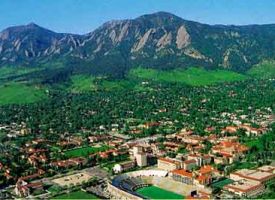
The natural beauty is breathtaking. Literally breathtaking. When I'm gone for long periods and come back, I can't get over how it looks like some artists rendition of a perfect town in a perfect setting. And by god, it is.

It's full of passionate people. Some are passionate about things most of the US would consider offbeat, some downright weird, but man, they care. Some school back east (Harvard maybe?) did a study that had the number of 'activists' (people who have position and aren't afraid to say so, and act on it) in Boulder was 'the highest per capita in the US'. How the heck they determined that I don't know (number of people arrested protesting Rocky Flats maybe?). It says one thing though: We care about what we care about. "The 60's" started in San Francisco, Berkeley and Boulder. I personally know some of the ‘activitists’ from the period (now upstanding business owners, lawyers and professionals in town – which is damned ironic) These guys took over the bulldozers the police tried to use to force them off the highway into Boulder in the late 60’s and set them on fire. Some of that spirit, deep in the heart of these now ‘establishment’ activists still lives on in Boulder.

For 5 years Boulder was one of the few cities in the US with it's own underground pirate radio station (most last for a couple of months, get a visit by the FCC and shut down, pansies). Only 2 other cities (Berkeley and Santa Cruz) had longer running pirate stations. Why's this matter? It shows people are paying attention to the media, didn't like what they saw, and did something about it. They become the media.

The range of people you can meet on the aforementioned Pearl Street Mall (an amazing place as well: a multi block walking mall packed to the gills as soon as the temperature gets about 60 degrees) is incredible. Street performers, college students, families, punks, homeless people, beautiful people, music venues, world class restaurants with just about any type of food you can imagine, 5 star hotels, scammers, millionaires, blues musicians hanging on the corner, you name it. There's about 100 blocks of culture from the average town packed into that little 6 or so block area.

Ride bikes? This is the place to live. In Boulder, you have as much right to the road (at least in theory) as the cars, and the city has one of the most extensive bike path systems in the country. It's actually a lot easier to get around town on a bike than in a car. It's certainly faster.

And the open space. It's (one) of the big reasons housing pricing are so high, but it's also why the town feels like, well, a town. Not a suburb. Large parcels of land around Boulder are owned by the city. Purchased over the years to create a greenbelt around the city. Come into Boulder on US36 and as you reach the crest of the hill that leads down into Boulder Valley, you can't help but think: wow... what an incredible place.

We can't leave out the University. It has it's problems (the athletic department could use some retooling) but parts of it are world class and with time, attention and care, it could become one of the best universities around. And, of course, if you like party schools, well, not so much anymore, but it's still got the rep.

I could go on. There's so much here it would be impossible to list it a single post, or even several.

I miss some of the weirdness of Boulder (Penny Lanes coffee shop, hangout for some of the most interesting characters in town, around for 20 plus years, recently was replaced by yet another bike shop) but hey.. the Tridents still there. One of the original coffee shops (I remember sitting in there while in College getting completely wired on Quad Americano's and studying with friends).

I guess I won’t move to Longmont after all. I guess, naaa.. I know.. I’m already home.

Wednesday, July 19, 2006

Boulder No Longer A Best Place To Live (?)


Ahhh.. so the rest of the country is finally figuring it out!

Fitter, hipper Boulder

City's successes can become excesses

July 19, 2006

Judging by Money magazine's list of America's best places to live, Fort Collins is No. 1. Longmont is No. 61. And Boulder is, ahem, not on the list.
This is from today's Daily Camera. Full editorial, click on the title of this entry (registration required) or this link:

URL: http://www.dailycamera.com/bdc/editorials/article/0,1713,BDC_2489_4853373,00.html

The author, who is interestingly left unnamed, nailed it. Being a middle aged non athlete (which I am) in Boulder, at times, sets me 'apart' from the crowd. Walking around the Pearl Street Mall, the beautiful people surround you. The perfect bodies, the oh so white teeth, the clear tobacco and caffeine free whites of their eyes makes me cringe at times.

I wonder if he's not being more than a little tongue in cheek though and I can't help but think at times that Boulder really has just gotten a bit full of itself and how cool it is. Kind of like a mainstream Vail or Aspen with a a few token trailer parks and mandated affordable housing (with a maximum income requirement of 'only' $70,000 a year to qualify).

Sometimes, I go to longmont, my hometown, where I grew up and where my parents still live, just to feel normal. Grab a dairy queen cone, have a greasy burger at one of the real diners, drag main (just once, for old times sake). You know... those 'comfort food' like moments.

Maybe I'll move to Longmont. Sometimes it feels more like home than Boulder.

Sunday, July 16, 2006

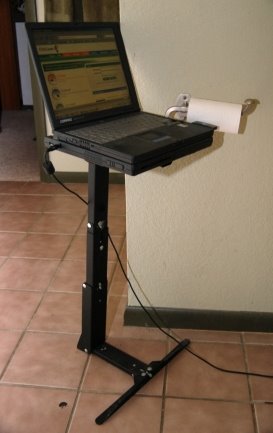
Our answer to Magazines in the bathroom? The Craptop!

That's right.

Take an old pretty much useless for anything but simple web browsing laptop you've got laying around. Put a basic wireless card into it. Put it on a stand and leave it in the public use bathroom.


Viola! The Craptop! No more heaps of magazines in the can! We love it.


Brought to you by the development team at ClickCaster !

(p.s. we're absolutely sure we're not the only one's who've done it, but what the heck).

Thursday, July 13, 2006

The Brit's Trump the RIAA for 'at least they have balls' actions


Man, it just keeps getting weirder out there in Music land.

The Brit's RIAA equivalents are now trying to shut down file sharing, in the strangest of ways.

ISP Battle Flares in Britain, Independent Artists Join In

ISPs are now at the center of a fresh controversy in Britain, sparked
initially by major label trade group BPI. The group recently sent letters to
access providers Tiscali and Cable & Wireless, demanding that the accounts
of specified file-traders be revoked. "It is now up to them to put their
house in order and pull the plug on these people," declared BPI chairman
Peter Jamieson. That prompted a sharp response from Tiscali, which scoffed
at the demands. "It is not for Tiscali, as an ISP, nor the BPI, as a trade
association, to effectively act as a regulator or law enforcement agency and
deny individuals the right to defend themselves against the allegations made
against them," the group noted.

Others within the industry are also rumbling against access providers. The
Association of Independent Music (AIM) is just one of several organizations
interested in updating copyright law to hold access providers liable for the
infringing activities of its users. The consortium favors a system in which
the ISP participates in the policing and monetization of content transferred
over the web. The group has been lobbying British officials, asserting that
ISPs unjustly enrich themselves through the delivery of high-speed services,
which often fuel activities like file-sharing. "For too long, the ISPs have
shirked their responsibilities, using music as a tool to sell their own
services, whilst making little effort to ensure fair payment to its
creators," said British Academy of Composers & Songwriters chairman David
Ferguson in a recent BBC interview. From a broader perspective, the
consortium also aims to receive payments from any company deriving value
from the sharing or storage of music, including MP3 device manufacturers,
ISPs and cellular operators.

Let's consider this for a second.

If the ISP's are 'responsible' and 'profiting' from this horrid illegal activity, where's the concept stop? When does it become the responsibility of all hardware manufacturers to 'stop' the horrid illegal activity (in the eyes of the Music Business) of 'playing' songs that don't have the proper DRM and control mechanisms on them? Damn those hardware makers! They are STEALING US BLIND by PLAYING OUR MUSIC (without letting us check every single file on the device to make sure it's been legally obtained). SHUT them DOWN we say!!

How about those irresponsible phone companies? Don't they allow drug dealers to TALK with each other? Could those dealers be selling drugs and making money off of it somehow? My GOD.. SHUT them DOWN. Turn off the phone networks.. NOW!

Of course I'm overstating the point here, but I think it's obvious: those who provide a platform for generic activity (be it an ISP, a phone company, a cable network, a software service) can't be held liable for what the people on it do. Especially if they're even reasonably successful. Trying to 'track' what millions of people do online (or on the phone, or on a service platform) isn't really viable. And even if it was, is it right? Do we enable big brother to step in and watch everything and pass judgment?

My question is: where does it stop? And who gets to 'say what's right'.

What if, for instance, some nutcase got into the White House and decided he or she could just look at or listen into anything, anywhere, that they wanted to, and then pass judgment on what he or she heard based on what they thought was important. Just because he or she could do it by virtue of the 'authority of my position' (true or not).

Man.. can you imagine something like that? I can't...

No .. wait... maybe I can....

Meta’s AI Gamble: Hype or Hubris?

  Meta’s AI Gamble: Hype or Hubris? Meta’s latest earnings call was a masterclass in optimism, with their leadership painting a rosy pictur...