Thursday, July 13, 2006

Apple Arrogance.. knocked down a notch


Well YEha!

Apple does the right thing! After doing the oh so wrong thing (and losing in it's attempt).

At least they know when they've lost and to quit being idiots.


Apple Drops Case Against Bloggers, Online Publications

Apple will not pursue its case against bloggers and insider websites,
according to court filings that surfaced this week. Earlier, a California
appeals court extended First Amendment protections to bloggers and online
publications, including PowerPage, Apple Insider, and ThinkSecret. The
original ruling also extended the Shield Law of California, which protects
the right of journalists to conceal their sources. The latest development is
a victory for online journalists, as well as the Electronic Frontier
Foundation (EFF), which defended the case against Apple. Over the next
several months, the ruling could also have a strong impact Apple and its
upcoming iPods releases, which are already the focus of heavy speculation.

Story by news analyst Alexandra Osorio.
When this first happened is when I started to really retool my opinion on Apple's general good intentions. Why would anyone SUE a blogger that was creating free pre-product hype around things coming down the road?

Does Apple actually think it's being truly innovative enough that no one's thought of a general product category (like a mixer that works with GarageBand... the subject of this lawsuit)?

It took me a while to really grok this (although I've always known it intellectually) but....to date, Apple hasn't actually introduced a single 'new' thing. By what I can tell.. not once in it's history. Even the PC, credited to Apple, was a second generation product (The Altair was there first). Graphical User Interface? Stole it from Xerox Park. HyperCard? Ever Hear of Xanadu Steve? iPod? Sorry.. Creative and Archo's where there first.

Basically, Apple takes OTHER great ideas, and makes them mainstream enough for people to understand and buy. And it market's them brilliantly. That's it. That's Apple's magic.

And no doubt, it's good magic. Hard to do well. But hardly revolutionary. It's really just good execution on good ideas, sexy packages and kick ass salesmanship.

Suing someone for 'leaking' their top secret oh so special unreleased product info (especially for a company so driven in the publics eye by hype) It isn't just silly, it's arrogant.

Wednesday, July 05, 2006

Raising money for an internet startup #2


Talking to the angels.

Should VC firms take the occasional angel plunge?

Is the internet ‘seed’ VC as we know it, dying off and will angels rule?

The phone calls and in person meetings start.

Brad and I set up a list of potential investors. About 50 total, from our respective contact lists. He sent out an intro email to his, and I sent one out to mine.

We keep a Google Spreadsheet (so either of us can access it anytime from anywhere) that lists everyone, tracks contact dates, latest contacts, actions, interest, total raised, amount still needed and misc. notes.

Over the last two weeks, I've talked to a about a dozen people. A couple of not now’s, but most are interested and will 'get back' with us. Cool. To be expected.

All of them were really interesting, really smart and nice folks. People I'd want to go out to dinner with! Quite different than the VC world we'd dabbled in earlier. (One exception.. this person acted like a silicon valley VC.. barely looked at me, just sort of looked out into space the whole time, acted bored, slight air of arrogance- there's always one I suppose).

Also very different from Corporate America where one in 20 or 30 people I worked with were people I would want to hang out with. I remember interviewing at Microsoft back in the early 90's and thinking at the end of the day that not one of these people would I want to hang out with or spend an evening out on the town with (50% of why I turned down the offers. The constant rain in Seattle was the other 50%.. once a Coloradoan.. well, you're stuck. Gotta have that sun!). I also recently read that corporations, especially the big ones, attract a higher percentage of psychopaths and... hmmm.. I digress....

VC's as Angel Investors?

One interesting thing of note did happen. Another local VC that I'd talked to a few weeks earlier (they had read some articles the local press has done on us and wanted to say hello) decided that they might want to participate in the angel round.

A VC firm doing Angel investing! What a concept! I thought: well, there's hope yet. The VC I met with was great. He was a normal guy. No airs. No going through the motions. Genuinely interested. A breath of fresh air.

But it wasn't to be. The amount was 'a few hundred thousand dollars'. (about 1/10th what they'd normally do). His partners (?.. someone.. not sure who exactly) looked at it in a way very similar to how all the other VC's looked at us several months ago. They looked at the 'risk' (high: we're early stage), they did an analysis of the competitors (we don't really have any for our target market.. yet, but they didn't hear that, or didn't believe it) and in the end they just couldn't bring themselves to do it.

I get it. If you have $100M (of which you take, 2-3% of a year to 'manage' plus 20% of profits earned) it's hard to invest less than $3-5million at a pop. You can only manage so many deals. And you have to justify that big hunk o cash you take out each year for management fees. And you MUST manage risk and have a few big hits.

And they couldn't do it even with a business that's got one of the best VC's around putting his own personal money into the company, a great team, a year of successful growth, a pipeline of business, customers and signed contracts (but, granted, no real money yet) all lined up. We're not a sure thing, no doubt, but as seed/angel early stage companies go, we're pretty nicely positioned.

I just don't get the us of the term 'venture' capital. According to Princeton University’s online dictionary, Venture means:

any venturesome undertaking especially one with an uncertain outcome

Right, uncertain outcome. Risk.

That's what Venture Capital means right? Uncertain outcome. Risk.

With the low cost of doing an internet startup now, I have to wonder if what Brad's doing by leading an angel round isn't just his usual angel activity but is really a precursor to the true future of internet VC type activity. The VC's that figure this out, I suspect, will do well.

Here's a link to an interesting post by a VC (Paul Kedrosky) who I haven't met, but who's blog I read:

The Seed (Venture Investing) Rules

He says:

The following figure (click above link to see this- SGC) self-summarizes venture guy Vinod Khosla's investment returns by amount invested, and then stratified by whether he had a board seat. The upshot: His highest returns came disproportionately from investments where he put in less than $1m, and from where he had a board seat.

I think this is going to be true more and more as VC's who invest in internet related businesses dive into things. Can they turn this into a sustainable investment model? Maybe.

It means people that put money into venture funds will have to learn to accept a different model (and set of returns) though.

Or, it might mean that Angel networks replace VC's in the early stage and seed rounds of startups. At least, for a few years. I suspect the VC's, current or next generation, will eventually figure out how to do it in a way that Limited Partners, the people who fund their firms, can get those 50% annual returns. However, based on what I've seen of the majority of VC's out there today, it'll take awhile, if it happens at all. And it'll be a small percentage of existing VC's (like Brad and folks that think like him) that actually make the hard (and smart) choice to do it.

But hey, that's just my opinion. I could be wrong.


What are the chances you'll get killed by terrorists?

Time for some perspective.

The terrorist attacks of 2001 were horrible. They need to be guarded against. BUT.. this is getting stupid. We are spending hundreds of billions of dollars (if you count 'the war on terror') on this 'threat'.

I've gotta ask.. in relation to other things that can kill us... what threat? I mean.. really. For some perspective, look at these odds:

Chances of dying in:

A Natural disaster (earthquake, tornado, etc.) 1 in 3,357

An Airplane crash: 1 in 6.4 million

A Terrorist attack 1 in 9.3 million (AFTER 9/11)

So, what's going on here? Why all this constant 'war on terror' talk? What actual war? What Terror- in comparison? All the wars I see we started.

I see a president who ignores common and constitutional law in the 'name' of the war on terror.
I see a country divided. I see individual rights being trampled on. I see freedoms being taken away. I see fear; a lot of fear.

I'm an independent. I vote based on the issues, not a party line, but I've never seen anything like this in my life. Even the criminal acts of Nixon don't compare to what's being done today and, effectively, ignored by our press and our elected officials.

It's disgraceful.

Sunday, July 02, 2006

Warning: You shouldn't talk, at all, in a car.


Now this is interesting:

Study: Hands-free phone not safer on road
Detroit Free Press - Jun 30, 2006
Drivers talking on cell phones are just as inattentive or likely to get into accidents as drunk drivers, even if they're using hands-free devices, according to a study published Thursday in the journal Human Factors.


I'm certainly not condoning it. I've cursed my fair share of people turning in front of me because they're on the phone, but, if this is true... doesn't it also mean if your just TALKING to someone.. anyone, like someone in the passenger seat or back seat, it's just as bad?

Monday, June 26, 2006

Patents spooky side


Ahhh.. Patent trolls. It takes one of the big brains who've made millions and left MicroSoft to do it at this level. I had a very interesting experience from my time at Motorola that was similar to this. I'll go into more detail after you read this

From TechDirt (www.techdirt.com):

Nathan Myhrvold's Bait And Switch Plan On Patent Hoarding

from the can-you-say-greenmail? dept

We've written about Nathan Myhrvold's dangerous plans to put hundreds of millions of dollars into hoarding patents many times before. Business Week is now running yet another article that tries to get to the heart of Myhrvold's plans -- though his company, Intellectual Ventures is being quite secretive. The article does discuss his "invention sessions" where he brings together a bunch of smart folks to brainstorm -- where the whole conversation is recorded and monitored by patent lawyers looking for anything they can file patents on. However, what's much more interesting is the story of how Myhrvold pulled a total bait-and-switch on the many big tech companies who represent his investors. The original business plan for Intellectual Ventures was to create a "Patent Defense Fund." The idea was to buy up all the available patents from the bursting dot com bubble and offer to license it to companies to protect them from patent infringement lawsuits from others using the typical nuclear stockpiling defense. However, these days, the company no longer discusses the patent defense fund. Instead, it refers to many of its own investors as "the patent infringers lobby." As the article suggests, it seems like the company basically convinced these companies to fund it based on this "defense fund" plan, by making it clear if they didn't invest, they would be the first targets for future lawsuits. In the meantime, would you trust any company that insists the patent system is just fine -- but doesn't seem to understand the history of innovation?

Spooky eh? But interestingly, this is alot more common than you might think. I worked for Motorola back in the 90's for a few years and had an experience similar to what's described in the businessweek article.

A group of us, mostly technical, a few marketing, went to a remote hunting lodge in Wisconsin. About 50 people with 3 Motorola patent lawyers. We spent an entire week doing nothing, all day, but coming up with ideas related (and many not related) the area we were working in (high speed wireless internet.. what we called at the time 4G). I think we walked out with about 400 potentials of which 150 were already written up by Friday afternoon when we left.

And that was one group of engineers out of a company with 10's of thousands. This was a regular practice. The reason for this was Motorola is a patent machine. As is IBM and several other technology rich companies in the US (and, interestingly, Japan.. who participates in this ritual in a similar way).

They don't actually build any of this stuff. They just apply for the patents so they can own the intellectual property.

These companies use these patents as a form of capital. They use it to get other companies with patents they want to cross license at no charge. To shut down competitors (especially little ones). And to protect themselves from people who might come up with new ideas (and actually implement them.. making them real) so they can't compete with the 'big' company and it's unused patent library. And, of course, they license the patents producing big money for the company. Last time I looked- late 90's timeframe, Motorola was collecting a little over $1 Billion (with a b) ayear in license fee's. Just for the patents they'd filed.

What Myhrvold's doing is really no different. He's just acting like the big guys have been for many years, and he's trying to turn it into a standalone business.

What makes it distastful to people is that he's being pure about his purpose. The big guys who do it are mostly focused on protecting other lines of business and, oh yea.. there's a billion or so of pure cashflow here.. let's grab it. They aren't 'trolls' And I don't see any other way to look at Myhrvold's actions here.

Our patent system (and don't get me started on software and process patents) is in desperate need of being overhauled. This is just one example of why.

Raising Money for an internet startup...


This should be interesting. Our company, ClickCaster, has taken a slightly different route when it comes to how we fund outselves.

We looked at going the venture capital route late last year and talked to a couple of dozen VC's. We even had some indepth talks with 3 or 4. The conclusion we came to was, it just didn't make sense to take VC money.

Much has been written about this by various bloggers, but experiencing it first hand was particularly interseting. We looked at what it would take to build a Web 2.0 type company, in our case, a podcasting business focused on directory services and creation tools with a social networking wrapper and we decided that we'd have a hard time spending $5M (or $3M) of VC money. At least, if we were being responsible.

It just doesn't take that much money to do this anymore.

And once you take that money, you start to trap yourself into high valuations to get the kind of returns those VC's are looking for. That, in turn, limits our options down the road (if you have to sell for $200-300M vs. $30M to provide a decent return, well, you get the idea).

So it turns out that, as an early stage technology company, VC money was available, and tempting (very tempting) but.. was it smart?

Not so much.

So we decided to lay back and build the service out more. We opened a public beta in late 2005 and just kept building it. We'd take user feedback, and add it. We'd take our users bug reports (everyday average users are WAY better at finding bugs than a formal test team) and fix them. And, interestingly, the customers started coming to us.

So we're in the process now of building a pipeline of business that uses ClickCaster, our service, as a platform that many other businesses can use. Small independent folks looking to promote a service, or a type of music, or an idea. Professionals with valuable information people are willing to pay for (which drove our creation of a commerce engine for people to charge for a single podcast, or a subscription to a series of podcasts over time).

And now we find ourselves with several contracts either signed, or about to be signed, and some pretty interesting businesses ahead of us.

And NOW, we need some money.

But not alot of money. Just enough is really all we want. The amount we think we can do it with is less than $1M. Now, for us at this stage, that's real money, but to a VC, it's not really worth their time.

So, we decided Angel Investment was the way to go.

I've been talking to a local VC here in Boulder named Brad Feld for over a year now. Great guy, very smart, get's the space, fair, open and tough. Exactly the kind of guy you want involved in an Angel round.

He offered a couple of months ago to lead an angel investment round if it looked like we really had a business and told me to come to him if I was convinced this was something we could really make fly.

So we continued development and we watched our usage numbers grow. From a few thousand users in Jan to almost 100,000 in May with over a million page views. OK.. we've got something here.

And that's where we are now. About to start a round of Angel financing. This is a first for me. Raising the money directy, in chunks, from wealthy individual investors.

I'm going to keep a sort of running story on the progress of it here. I'll change names to protect the innocent, and, hopefully, learn something about the process.

Wednesday, June 21, 2006

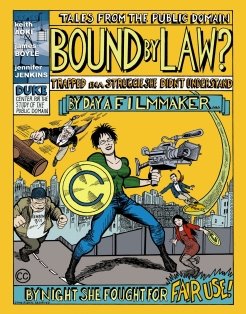
Will a spiky-haired, camera-toting super-heroine... restore decency and common sense to the world of creative endeavor?

A documentary is being filmed. A cell phone rings, playing the “Rocky” theme song. The filmmaker is told she must pay $10,000 to clear the rights to the song. Can this be true? “Eyes on the Prize,” the great civil rights documentary, was pulled from circulation because the filmmakers’ rights to music and footage had expired. What’s going on here? It’s the collision of documentary filmmaking and intellectual property law, and it’s the inspiration for this new comic book. Follow its heroine Akiko as she films her documentary, and navigates the twists and turns of intellectual property. Why do we have copyrights? What’s “fair use”? Bound By Law reaches beyond documentary film to provide a commentary on the most pressing issues facing law, art, property and an increasingly digital world of remixed culture. This book is available under a Creative Commons Attribution-
NonCommercial-ShareAlike license
.


I'm all for intellectual property. People that create should be compensated. But what the hell? I mean CHARGING FOR A RINGTONE IN A DOCUMENTARY? Are you kidding me?

This is essential stuff. Everywhere we look, more and more things are being removed from the 'I can do that' list of life. Read this (comic) book. It's substantially more dense then Spider Man, but it's a much better read.

Download this comic book here:
http://www.law.duke.edu/cspd/comics/pdf/cspdcomicscreen.pdf

Listen to an interview with the author (James Boyle) here: http://www.ibiblio.org/wunc_archives/sot/index.php?p=684

Meta’s AI Gamble: Hype or Hubris?

  Meta’s AI Gamble: Hype or Hubris? Meta’s latest earnings call was a masterclass in optimism, with their leadership painting a rosy pictur...