Tuesday, June 20, 2006

Another reason DRM is a bad idea


This quick tidbit, from TechDirt, outlines yet another reason DRM, in it's current incarnation(s) is a bad idea.

Besides locking people into hardware (iTunes/iPod) and making it difficult to USE equipment you own (try moving a DRM's .WMA file to your MP3 player sometime), what if the store that 'validates' your DRM files goes away?

And Coke ain't no little company. It's just dropping this 'particular' business.

  • Latest Entertainment Digital Strategy: Incidental Obsolescence

  • from the hmmmmmmm dept

  • One of the Guardian blogs has a post involving the demise of the MyCokeMusic download store, at one time the biggest download store in Europe. It raises an interesting question, though not one the post actually hits on -- what happens for consumers when a seller of DRMed media files shuts down? With things like cassettes, LPs or CDs, their obsolence can really be determined only by a lack of available playback equipment. But for locked-down digital files, particularly those using a mechanism that has to go out and validate a license from a content provider or another authority, the closure of such an entity could render files unplayable. One of the downsides of current DRM implementations is a lack of interoperability. It's hard to imagine that those interoperability problems won't get worse, particularly as some of the music download sites that have popped up go out of business. Of course, with so much of modern entertainment strategy revolving around getting consumers to pay for the same content multiple times, it's hard to see Big Content really caring.
Check out the www.techdirt.com guys for stuff like this daily. VERY insightful group (if you don't mind a little vinegar with your news and opinions).

The lesson here? Don't buy DRM'd media, period.

How? Buy the CD (or DVD) and rip it. At least, then, you have control over your digital file and you've (legally) obtained your media.

Yes Virgina.. the Telecoms are screwing you


This guy has written a book on just how badly we've been served by the telecom industry in the US.

For a SHORT TIME a download of the book is free (Till June 26th) at this link:

http://www.teletruth.org/docs/BROADBANDSCANDAL.pdf

It's big. 400 plus pages. But it makes the very clear case that our telecommunications companies can't be trusted to serve the public in any way other than maximizing profit.

Now, I have NOTHING against profit (or maximizing it). But if you're lying and stealing to do it.. well, not so much. If you take, you should also give. It's a balance (karma?) thing.

The Net Neutrality debate falls squarely into this area as well. Not only have these companies been scewing your for decades, they want still more.

Here's short overview of the book:

Bruce Kushnick, bruce@teletruth.org 718-238-7191

To Read this as a PDF file

Summary:

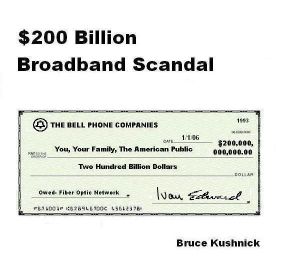
$200 Billion Broadband Scandal

This book documents the largest fraud case in American history

The case is simple: Do you have a 45 Mbps, bi-directional service to your home, paying around $40? Do you have 500+ channels and can choose any competitive service? You paid an estimated $2000 for this product even though you did not receive it and it may never be available. Do you want your money back and the companies held accountable?

Background: Starting in the early 1990's, the Clinton-Gore Administration had aggressive plans to create the "National Infrastructure Initiative" to rewire ALL of America with fiber optic wiring, replacing the 100 year old copper wire. The Bell companies SBC, Verizon, BellSouth and Qwest, claimed that they would step up to the plate and rewire homes, schools, libraries, government agencies, businesses and hospitals, etc. if they received financial incentives.

The Commitment:

  • By 2006, 86 million households should have already been wired with a fiber (and coax), wire, capable of at least 45 Mbps in both directions, and could handle 500+ channels.
  • Universal Broadband: This wiring was to be done in rich and poor neighborhoods, in rural, urban and suburban areas equally.
  • Open to ALL Competition: These networks were to be open to ALL competitors, not a closed-in network or deployed only where the phone company desired.
  • Each State: By 2006, 75% of the state of New Jersey was to be wired, Pennsylvania was to have 50% of households by 2004, California to have 5 million households by 2000, Texas claimed all schools, libraries, hospitals.…Virtually every state had commitments.
  • Massive Financial Incentives: In exchange for building these networks, the Bell companies ALL received changes in state laws that gave these them excessive profits, tax savings, and other perks to be used in building these networks.
  • This was not DSL, which travels over the old copper wiring and did not require new regulations.
  • This is not Verizon's FIOS or SBC’s Lightspeed fiber optics, which are slower, can't handle 500 channels, are not open to competition, and are not being deployed equitably.
  • This was NOT fiber somewhere in the network ether, but directly to homes.

The Harms and Outcome

  • Costs to Customers — We estimate that $206 billion dollars in excess profits and tax deductions were collected over $2000 per household. (This is the low estimate.)
  • Cost to the Country — About $5 trillion dollars to the economy. America lost a decade of technological innovation and economic growth, about $500 billion annually.
  • Cost to the Country — America is now 16th in the world in broadband. While Korea and Japan have 40-100 Mbps at cheap prices, America is still at kilobyte speeds.
  • The New Digital Divide The phone companies current plans are to pick and choose where and when they want to deploy fiber services, if at all.
  • Competitor Close Out SBC, BellSouth and Verizon now claim that they can control who uses the networks and at what price, impacting everything from VOIP and municipality roll outs to new services from Ebay and Google.

The Truth: This is a Fraud Case

  • Fraud: There is a dark secret — the networks couldn't be built at the time the commitments were made and are still not available. If someone pays thousands of dollars for a service and doesn't get it, isn't that fraud?
  • Collusion and Cover-up: TELE-TV and Americast, the Bell companies' fiber optic front groups, spent about $1 billion and were designed to make America believe these deployments were real in order to pass the Telecom Act of 1996 and enter long distance. How did every major phone company in America not know that these fiber-based services couldn't be built and were able to defraud over 40 states?
  • The mergers killed fiber optic deployments in over 26 states and harmed competition. With every merger, the phone companies simply dropped all state commitments and harmed every state they merged with. Case in point: Verizon cut deployments to 13 states during the NYNEX-Bell Atlantic merger, not to mention GTE's 28 state deployments. SBC did the same in all 13 of its states, from California to Illinois. Worse, the mergers were based on the companies competing with each other and there is NO evidence they ever did any serious wireline residential competition.
  • The Regulators Killed Competition and Broadband. Over the last 4 years, instead of continuing competition as ordered by the Telecom Act of 1996, the FCC has rewritten the laws close down Internet Service Providers (ISPs) that brought America to the Internet, as well as virtually all local competition. AT&T and MCI couldn't compete because they were regulated out of business and thus were sold off.
  • Distortion of the Truth by the FCC. Virtually every piece of documentation presented in this work is missing from the FCC's Advanced Network Reports. The FCC defines broadband as 200 kilobytes per second in one direction — 225 times slower than what was promised in 1992.
  • Cross-Subsidization — Instead of spending the money on these networks, the Bell companies used the money to enter long distance, rollout wireless and the inferior DSL services. The Bells also lost over $20 billion overseas and paid executives over a billion in stock options during the mergers.
  • Bait and Switch — Customers paid for a fiber optic wire and got DSL over the old copper wiring — it's like ordering a Ferrari and getting a bicycle.

20 Year Analysis of Revenues, Profits, Expenditures: This book is based on a 20 year analysis of Bell-supplied data, Census Data and Business Week. Since 1984::

  • Revenues are up 128%.
  • Employees are down 65%, Construction is down 60%.
  • $92.5 billion is missing in network upgrades.
  • Profits based on failed fiber plans up 188% as compared to other utilities.

Teletruth has filed a complaint with the Federal Trade Commission, (FTC) to investigate the claims presented; the book is the data for our complaint.

Do you care about Net Neutrality? You should.


What's the big hoopla about Net Neutrality? Why should you care?

Well, you should. It means less choice and less competition, especially in our world (internet startups).

It's very likely that ClickCaster, a podcasting company based in Boulder, CO. would not exist if we had to pay 'extra' fee's beyond the costs we currently pay to provide our service. Frankly, if low cost high speed bandwidth hadn't been available when we started ClickCaster... well, we simply wouldn't have started it.

The low (relative) cost of bandwidth, and the fact that we're on a level playing field with Apple’s iTunes, Google, Yahoo and Comcast (as far as the internet is concerned) is what enabled us to start the company.

Take that away, add additional costs to getting the company started, and it's possible and even likely we just wouldn't have done it at all.

Here's a quick overview of something in USA Today that sums it up nicely:

  • Internet Fast Lane Marginalizes Smaller Web Firms
  • USA Today
  • USA Today spoke with several small businesses about the possible effects of an Internet fast lane on their business. Many of these companies are helping lead the push for "net neutrality" laws, which received a major blow a few weeks ago as one of many bills defending net neutrality was struck down by the House of Representatives. Internet service is currently "neutral" in most instances, meaning that content providers don't have to pay extra if their video service sucks up more bandwidth than, say, a blog. This is because network owners deliver information over their pipes to users' computers at the same speeds. If lawmakers fail to pass legislation guaranteeing network neutrality, that could all change--soon. "That would be a disaster for little companies like ours," a CEO of an online video startup told USA Today. The Web, the so-called "Great Equalizer," would no longer be equal for companies that can't afford to pay for faster delivery of their content. This would skew heavily in favor of larger companies like Google, because they could--however reluctantly--afford to pay these surcharges. But it might discourage them from spending on R&D in bandwidth-heavy areas like broadband video. The future of entertainment on the Web depends on faster speeds, and content providers agree that a "fast lane" would simply stymie competition--to the detriment of both consumers and the Web industry. - Read the whole story...


Make no mistake, this is a big deal for everyone. Not just us little web based startup companies. ALL the big guys on the internet today started as little web based startups like us. All now employ thousands of people and produce billions in revenue and shareholder value.

Cut out the little guys ability to get started and you radically cut the number of potential big guys down the road. The end result: A few monopoly like players that control the market AND a lack of innovation. Most of the 'cool' stuff the big guys do comes from little guys they either copy or buy up. A few of us little guys actually grow up to BE big guys. And that keeps things moving forward. ClickCaster wouldn't exist today if the net weren't neutral. If we were required to pay 'extra' just to compete at the same level as the big guys (fast bandwidth, nicely shaped packets that get to our customers at the same time and same speed as Yahoo Video's, or iTunes) we simply wouldn't have started the company. We'd be working at Comcast or Apple or Yahoo. We'd be doing interesting things, no doubt, but true innovation? Not so much.

Email your congressman or senators. Tell them you actually care about Net Neutrality being real because, in the long run, you really do. It may not be obvious to the average person today, but it effects you, your children and your work, in a big way.

Thursday, June 15, 2006

Denver #6 per capita for Starbucks

Let Starbucks Find You a Place to Live

It seems that every week some organization or another comes out with a list of American’s best cities. These lists go by different names (Most Livable Cities, Best Places, whatever), but some how they all end up with similar content. They have Seattle, San Francisco, Boston, Portland, and the like near the top of the list, and Detroit and New Orleans near the bottom (here’s a good recent example, the Sustainable Cities list).

These lists are good and useful, but it turns out that if you just list cities by the number of Starbucks locations per capita, you get a pretty similar result. Here are the largest US cities from most to fewest Starbucks per person:

  1. Las Vegas
  2. Seattle
  3. Portland
  4. Sacramento
  5. Washington
  6. Denver
  7. Atlanta
  8. San Francisco
  9. San Diego
  10. Cincinnati
For the entire list (and the rest of this blog post).. go to: http://www.citytowninfo.com/wordpress/2006/06/05/let-starbucks-find-you-a-place-to-live/

technorati tags:,

Blogged with Flock

Tuesday, June 13, 2006

Denver/Boulder- One of the best places to do a startup company


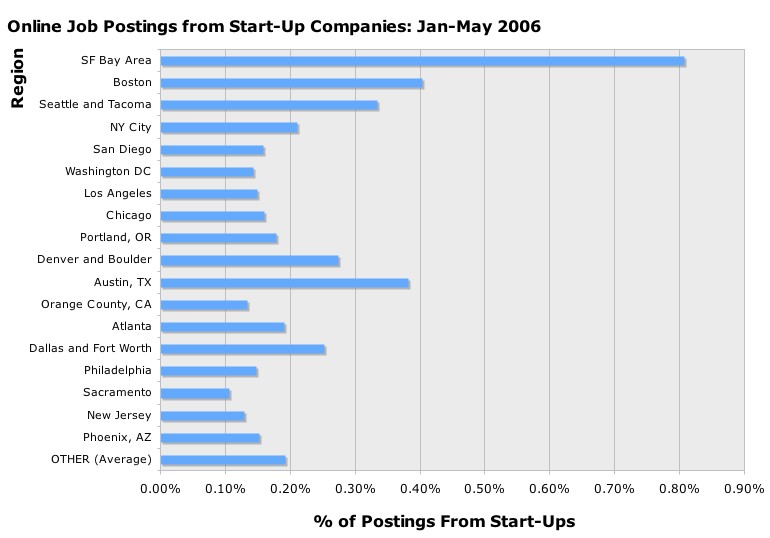
Paul Graham recently did an essay on what it takes to create an environment like Silicon Valley (Boulder and Portland were ID'd as top candidates).

Some additional data is coming out, in particular, Tim O'Reilly's blog (click on the title of this entry to go directly to his post).

What's interesting is the above chart.

Apparently, we're number 5 for startup oriented hires in the US. Not bad for a region that's smaller (by millions) than the 4 above it.

So, if you're interested in starting a company, and you don't want to deal with Silicon Valley, it doesn't get much better than Boulder.

Saturday, May 27, 2006

Bloggers, it seems ARE journalists afterall


Apple, last year, sued a Silicon Valley blogger for releasing information about an unreleased product citing it was not news. They tried to force the bloggers ISP to give up the email addresses (in an attempt to find someone within Apple who was 'leaking' information). Click on the title of this entry to read the full story on Wired News (excerpt below):

  • The Sixth District Court of Appeals on Friday roundly rejected (.pdf) Apple's argument that the bloggers weren't acting as journalists when they posted internal document about future Apple products. "We decline the implicit invitation to embroil ourselves in questions of what constitutes 'legitimate journalis(m).' The shield law is intended to protect the gathering and dissemination of news, and that is what petitioners did here," the court wrote.
Now, this is a minor thing from a business or technology perspective. In the greater scheme, who really cares if Apple's releasing some new hardware of software (other than Apple fans).

What IS big, is that this court decision sets a precedents.

It means that bloggers, or podcasters (such as those on our service at ClickCaster) have the same protections as a journalist in protecting sources.

Of course, the argument can be made that those protections are being slowly ground down by current government actions at the federal level (The "Judy's in Jail"... NYT's reporter spending a month or two in jail for not giving up sources), but, at least, bloggers and podcasters now have the same right to say no.

And ISP's won't have to give up emails to specific accounts at the drop of a hat.

Does it create an impenetrable shield? No. Does it make it harder for those who want to quash the flow of information out into the world? Yes. And that's a good thing.

Monday, May 22, 2006

The Cool Kid factor- Why Google's Stock Price Stays High


Don Dodge, a blogging Microsoftie... (http://dondodge.typepad.com/the_next_big_thing/)

Wrote an interesting blog on how Google doesn't actually tell you how it works. (click on this entries title to read it).

He notes that even though no one knows how it works, the stock price continues to be bid up.

How dare these upstarts at Google ignore the financial worlds demands for more information on how things work! Damn them I say... Damn them..

But buy some more of their stock.

It's the cool kid thing. None of us know it in school (even though it's obvious as we grow older and wiser) but the cool kids are the ones who just don't give a frak about being cool. Zen at work. The less you care about being cool, the cooler you are. Sociology 101 stuff, but it applies here as well.

The reason the analysts are so enamored with Google, keep buying their stock and bidding up the price is that Google just flat out doesn't care what the analysts think, they're going to do what they consider to be the right thing and the hell with what anyone, including Wall Street, says.

That's why they don't tell anyone how it works. They don't care if you don't buy their stock and that is why you so want to buy their stock. Cool Kid Syndrome at it's best.

Meta’s AI Gamble: Hype or Hubris?

  Meta’s AI Gamble: Hype or Hubris? Meta’s latest earnings call was a masterclass in optimism, with their leadership painting a rosy pictur...