Wednesday, March 08, 2006

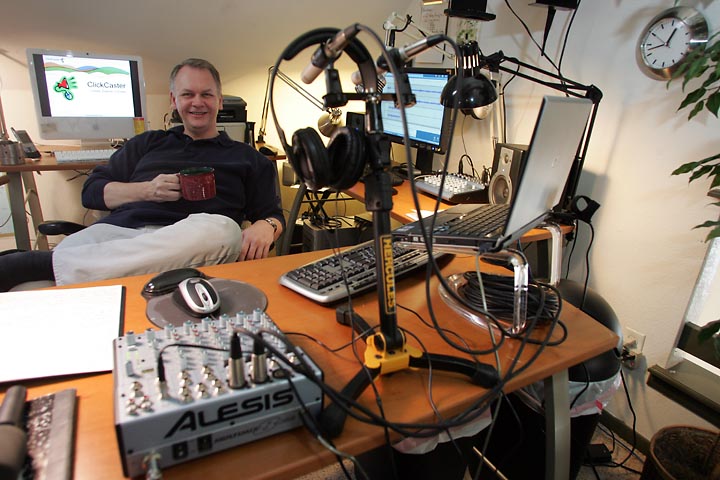
Scott's Podcasting Setup #2


Well that was fun. The Boulder County Business Report is doing a profile on ClickCaster, so they sent a photographer over (great guy named Steve Peterson, email him if you're looking for a freelance photographer in the Denver area.. he's at steve@terrachromea.com).

What struck me about this was the validation of Gladwell's concepts around "Blink" (your initial take is usually the best take).

This photo was the quick snapshot he took when he first started the photo session. We then did a bunch of other things (putting a bunch of mics around my head, etc. etc.) for about two hours.

In the end? Used that initial snapshot he took off the cuff.

"Blink" at work, real world. ;-)

Monday, March 06, 2006

Scott's Podcasting Setup

After much investigation, and after talking to our podcasters, here's the setup I've got for podcasting. Pretty simple really and it works beautifully for creating a 'live' type radio show with mulitple inputs and simple clean creation.

It consists of 5 components.

1) ClickCaster website (free)
2) Standard laptop computer ($500)
2) Alesis MultiMix USB8 mixer ($149)
4) Shure 55SH II Mic & Boom arm ($199)
5) Behringer Pro Headphones ($24)

I have to admit, I got this mic because it just plain looks cool. It's a 'retro' design with a modern set of internal electronics.

The mixer is a USB mixer that acts like an external sound card. Why anyone would by a $150 Creative soundcard when they can get something like this for the same cost is beyond me. 8 inputs (including 4 high quality microphone XLR connectors with phantom power for condensor mics, which require power) and a USB connection that feeds straight into the laptop. The beauty of this mixer is it's simplicity. Plug it into your Windows XP computer and it just works. No drivers to install, nothing. And the ClickCaster website just automatically recognized it as the main audio driver and worked. I didn't touch a thing.

You plug in the mic to the mixer, bring up ClickCaster, hit record and go. To play music, you just launch Winamp or MediaPlayer and play your songs. They route through the USB Mixer, just like the Mic, so you can talk over the music very easily.

So, you just hit record on ClickCaster, have your playlist ready on Winamp, and off you go. Do it just like live radio. Plug in additional mics if you have buddies you'd like to include in your show and it all just works.

Once you finish recording (which, again, is one click.. 'record'), you hit the stop button (ohhh.. two clicks!) and type in some show notes on what your episode was about (people on the show, music you played, whatever you like). Throw in some pictures to the show notes while you're at it.. hmm... nice.. looks good.

And now, the third, and final CLICK. Hit publish. Ahh... it does ask one last time if I want to save a copy on my personal computer.. yes.. click yes.

I'm done! It's encoding MP3 onto my machine... then, once it's done with that, it uploades the file to ClickCasters servers and I'm done. I've got a fully formated and subscribable podcast published on the internet.

Sweet.

Wednesday, March 01, 2006

ClickCaster Studios Opens!


Well, we did it.

ClickCaster's opened a podcasting studio in Denver.

It's a little on the low rent side. We thought.. hey.. take a low rent location (a cute, but slightly run down, little house with cheap rent) and turn it into a place where people can come to do regular podcasts. Hold their hands, give them pro level gear to work with and sound engineering help so it sounds professional and let it rip. I suspect it'll become a sort of gathering place as well. We'll see as it develops.

Of course, we can do other things besides podcasting, like record bands, radio spots, etc., and we've got a full time artist on staff who can do artwork, website design and other related creative, but it's focus is Podcasting. As far as we know it's the only dedicated podcasting studio linked to an easy to use online system that let's you get your podcasts online the instant you're done with them on the planet. I could be wrong on this, but I haven't heard of anything else like it just yet.

Here's our press release (going out worldwide today):

ClickCaster Studios, Podcasting with Altitude!Creates industry’s first Integrated PODCAST Net-Studio for the general public!

Denver, Colorado, February 26, 2006 – ClickCaster opens podcasting centric recording studio in downtown Denver.

Studio Location:415 Lincoln Street

Denver, Colorado 80203

Phone: 720-227-0129

Email: bob@clickcaster.com

Altitude: 5280 feet above sea level

ClickCaster announces the grand opening of ClickCaster Studios, a full featured podcasting and recording studio. The studio offers a full line of podcast and general audio services as well as custom site design and artwork.

“ClickCaster wants to make podcasting easy for everyone, regardless of what equipment they happen to own. While our web based recorder will allow you to create a basic show, some podcast creators and many businesses interested in podcasting want to sound more polished and produced. That’s where ClickCaster Studios comes in”, notes Scott Converse, ClickCaster CEO. “Armed with years of recording and broadcast experience as well as the necessary pro audio technology, ClickCaster Studios can make you a star, or at least sound like one.”

Standard prices apply for sessions that can be booked for ½ hour or one hour shows and recording packages are priced as low as $25 per session. We also have a full multi-track recording studio for bands interested in low cost recording and promotion of their music using podcasting. In addition to podcast production and recording, ClickCaster Studios has integrated ClickCasters’ web-based publishing and distribution technology, allowing customers to publish their podcasts seamlessly onto the web.

“It’s a true professional level one stop shop for the creation, production, publishing and hosting of your podcast on the internet” say’s Bob Boyles, general manager of ClickCaster Studios.

The Denver studio is the first of many ClickCaster and ClickCaster affiliated studio’s that will be opening in major cities across the US, Asia and Europe.The studio is located at the corner of 4th and Lincoln in downtown Denver (425 Lincoln St) and is open M-F 10am-6pm and Sat. noon to 5pm. Other times available by appointment. For more information please contact Bob Boyles at 720-227-0129 or e-mail studio@clickcaster.com.

About ClickCaster

Clickcaster is the premier provider of net-centric podcasting solutions on the web today. We make it easy for anyone to create audio podcasts and publish via the web both audio and video based podcasts as well as listen, watch and subscribe to 10's of thousands of podcasts from around the world. For more information about ClickCaster and podcasting, please visit our website at www.clickcaster.com or contact Pete Davis.

PR Contact

Peter Davis

Clickcaster

Phone: 407-733-9266

Email: peter@clickcaster.com
Sunday, February 26, 2006

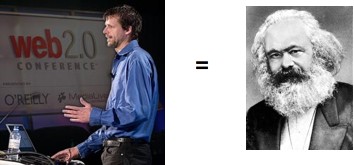
Web 2.0 and Marx (?!?)


Does Web 2.o = Karl Marx?

Interesting article from CBS (?). Click on the title of this posting to go direct to the article (or paste this into your browser:

http://www.cbsnews.com/stories/2006/02/15/opinion/main1320641.shtml

It's REALLY intersting. He's comparing the whole Web 2.0 world (what the internet is becoming and something we, ClickCaster, are focused on as a company) to Karl Marx.

The author (a Fellow named Andrew Keen from, it seems, News Corp.. hmmm) references Lawrence Lessig as being an Intellectual Property Communist (twice). Lessig created something called Creative Commons (www.creativecommons.org) that provides a different way of licensing intellectual property which is much more open and built on top of the assumption that intellectual property can be shared (and, at the same time, owned by it's creator).

Ever talk to Lessig? He's more of a capitalist than people know. He's just able to see beyond the current model to the next model. He understands what 'the Network Effect' is within a legal intellectual property context. (short network effect lesson: one fax machine: useless. two fax machines: useful. A million fax machines: really useful. Every new fax machine added to 'the network' the more valuable each new fax machine becomes. Same with user generated media like blogs and podcasts- Each new piece of media, that can be built on by others... via Lessig's creative commons licensing, has a similar network effect.. but in the media space. I know.. the connection isn't intuitively obvious.. but trust me.. it's there and Lessig completely get's it).

This article was written by a guy who (obviously) is threatened by the way media is changing (as he should be. Old School thinker that he is).

The old saying: "The power of the press belongs to those who own one" was never more true. Started with the Mac and a laserwriter.. Web 2.0 is just a logical extension of that trend and started back in the mid 80's when everyone could 'own' their own printing press (i.e. a Mac & a Laserwriter).

Clever title though (Web 2.0 Is Reminiscent Of Marx). I actually laughed out loud when I read it (and thought: what a riot.. this guy has no clue how far from wrong he is) I'll admit that it's a bit of a paradox (high tech capitalists talking about revolution of the media) but, trust me.. it's all about capitalism. The individual. Making money. AND doing it in a way that's 'good'. Things Ann Rand would have loved.

This is simply the (currently assumed) best approach to meeting the market demand for what people really want (which is what, in the end, the market IS, afterall). ;-)

Old media is scared sh*tless right now. And it should be. It's under siege, and it's losing, for the first time in it's history. And not just on an attention level, but on an economic one. The dot com bust was the best thing that ever happened to technologists like me. It made it really obvious that a solid business model and way of making money from the 'idealism' of our products was paramount. So, we adapted. And we're doing it, first, by deconstructing and replacing the old (and taking money out of their pockets). And the old media? Well, it really, truly, doesn't know what to do about it. Other than calling Web 2.0 'Marxist'.

Wednesday, February 15, 2006

How to kill your business or The RIAA's take on Fair Use

It just keeps getting weirder...

Deep Links

RIAA Says Ripping CDs to Your iPod is NOT Fair Use

February 15, 2006

It is no secret that the entertainment oligopolists are not happy about space-shifting and format-shifting. But surely ripping your own CDs to your own iPod passes muster, right? In fact, didn't they admit as much in front of the Supreme Court during the MGM v. Grokster argument last year?

Apparently not.

As part of the on-going DMCA rule-making proceedings, the RIAA and other copyright industry associations submitted a filing that included this gem as part of their argument that space-shifting and format-shifting do not count as noninfringing uses, even when you are talking about making copies of your own CDs:

"Nor does the fact that permission to make a copy in particular circumstances is often or even routinely granted, necessarily establish that the copying is a fair use when the copyright owner withholds that authorization. In this regard, the statement attributed to counsel for copyright owners in the MGM v. Grokster case is simply a statement about authorization, not about fair use."

For those who may not remember, here's what Don Verrilli said to the Supreme Court last year:

"The record companies, my clients, have said, for some time now, and it's been on their website for some time now, that it's perfectly lawful to take a CD that you've purchased, upload it onto your computer, put it onto your iPod."

If I understand what the RIAA is saying, "perfectly lawful" means "lawful until we change our mind." So your ability to continue to make copies of your own CDs on your own iPod is entirely a matter of their sufferance. What about all the indie label CDs? Do you have to ask each of them for permission before ripping your CDs? And what about all the major label artists who control their own copyrights? Do we all need to ask them, as well?

P.S.: The same filing also had this to say: "Similarly, creating a back-up copy of a music CD is not a non-infringing use...."

Machine Generated Culture vs. Editorial Perspective


Something hit me recently about the value of culture defined by google vs. blogs. Machine readable culture vs. editorial.

Which is better? Which do I (in the gestalt) trust more?

Ask yourself this: when you want to form an opinion about something, your very own personal opinion, what do you do? Do you go Google and search or do you read blogs written by individuals you trust or, at the very least, are entertained by?

Google is the collective mind. The wisdom of crowds. The value of results computed by the sum total of links to the highly rated hits.. machine generated from the internet.

Blogs are individual voices from specific minds of people you know (or know of through their blogs). Many are deep experts in areas that you might be interested in. Some are just plain smart and interesting to read.

I do both, but I'm finding myself, more and more, searching for that individual voice (or voices) on particular topics, that I think has a ring of truth to it.

Of course, I often use Google to find these voices. The whole damn thing is circular as hell when you approach it that way.

Then, there's the personal recommendation thing. For instance, I like a couple of VC blogs. One from Brad Feld, a Colorado based VC and exceptionally straight shooter, damned smart and all around good guy. And a fellow named Fred Wilson in NYC.. same general description.

How did I find them? Through friends. Folks I trust telling me 'you've gotta read these guys blogs'. It helps to actually meet them as well (Brad, who's local to me, I've met and Fred's geographically a bit too far, so it's only been a bit of email).

It's funny though how I feel like I really know these guys. They're a part of my daily life. I subscribe to around 100 or so blogs and I read some percentage of them every day, Brad and Fred (along with 10 or so others) I ALWAYS read.

I read them more than I bother reading my $99 a year online Wall Street Journal. And in their specific area of expertise, I trust them (far) more than I do anything written in the Wall Street Journal or that I find through a Google search.

So... having thought this out via writing it down here, I think I have my answer: Blogs are 'more' real, from an informational trust point of view, than Google (or any other machine generated culture).

I love the gestalt.. the global mind. I have faith in the wisdom of crowds. But in the end, I TRUST individual minds like those owned by Brad and Fred.

Monday, February 13, 2006

We finally got our blog up


Well, that took too long.

We finally got our official blog up and running. We've had one for months, but the development team convinced me it would be bad form not to have it running on our own software (I was pushing to a typepad or (gasp) blogger account.. just to get something going).

So, it's there. Check it out at: www.clickcaster.com/blog

Creative name eh? Heh. whatcanyado?

Meta’s AI Gamble: Hype or Hubris?

  Meta’s AI Gamble: Hype or Hubris? Meta’s latest earnings call was a masterclass in optimism, with their leadership painting a rosy pictur...