Monday, May 22, 2006

The Cool Kid factor- Why Google's Stock Price Stays High


Don Dodge, a blogging Microsoftie... (http://dondodge.typepad.com/the_next_big_thing/)

Wrote an interesting blog on how Google doesn't actually tell you how it works. (click on this entries title to read it).

He notes that even though no one knows how it works, the stock price continues to be bid up.

How dare these upstarts at Google ignore the financial worlds demands for more information on how things work! Damn them I say... Damn them..

But buy some more of their stock.

It's the cool kid thing. None of us know it in school (even though it's obvious as we grow older and wiser) but the cool kids are the ones who just don't give a frak about being cool. Zen at work. The less you care about being cool, the cooler you are. Sociology 101 stuff, but it applies here as well.

The reason the analysts are so enamored with Google, keep buying their stock and bidding up the price is that Google just flat out doesn't care what the analysts think, they're going to do what they consider to be the right thing and the hell with what anyone, including Wall Street, says.

That's why they don't tell anyone how it works. They don't care if you don't buy their stock and that is why you so want to buy their stock. Cool Kid Syndrome at it's best.

Thursday, May 11, 2006

The Macintosh: To Develop or Not To Develop.. that is the question.

A blogger named Jon Watson (http://www.jonwatson.ca/) recently heard an interview I did with the 411podcast some time ago. He said:


Clickaster: Stats and Why Apple Sucks.

By Jon at Fri, 2006-05-05 09:22

clickcaster

During my first real day as a pro-blogger today, I was listening to podcasts in the background as I created my posts for Biz Podcasting.

While listenening to Scott Converse - CEO of Clickcaster - from the Podcast 411, a couple of interesting stats came out. Apparently the vast majority of podcasters are males between 30-40 years old (guilty!), and that blogging has reached about 43% women.

He ALSO said that his development priority is Windows, Linux and then Mac because...well...he hates Apple's way of closing things off.

Robb and Scott actually go a little head to head on Apple and tensions get a little high at one point. Cool show.


And, so, I felt compelled to add my 2 cents worth:

Just as an interesting

By Scott Converse (not verified) on Thu, 2006-05-11 16:09

Just as an interesting aside, I agree that things did get a bit heated in my discussion with Robb. And, yes, I do have some pretty strong Apple preconceptions, primiarly due to having worked for Apple in Cupertino for the better part of a decade. I ran the R&D for all of Apple's online services development and had a pretty up close and personal view of how things work there. Apple has a way of doing things that's all about control. It's really a philosophical thing, some would say religious. And I, at one time, had the religion more than most.

What I see Apple doing now with the iPod and iTunes is very similar to what they did with the Mac in the 80's and 90's. A closed, completely controlled system that benefits Apple (and it's users.. no doubt). The reason is a good one: The user experience. That is THE driving force in all that Apple does. And it does it at the expense of everything else, including an open user driven community. Jobs is in control, period. Much has been written about this over the years so I won't go into it here.

I'll also share some stats from ClickCaster (which defines how we develop). Here are todays usage figures from ClickCaster:

Windows: 81.7 %
Linux: 12.2 %
Macintosh: 5.2 %
Other: <1%

And this has been pretty consistent since we started in September of last year.

I would agree with Robb that alot of todays early podcast creators are Mac users (mostly due to Garageband, the easy to use recording software that ships with every Mac). He got his numbers by talking to about 100 people (via interviews on podcasting) and about 1/2 of them used Macs. That was the extent of his research. Our numbers (above) are based on hundreds of thousands of users per month that visit ClickCaster. I’m not saying he’s wrong, I’m just saying we have a much richer and more extensive sample to draw conclusions from.

In our opinion, Robbs 50% figure is an early market anomaly that's going to change over time. Services like ours make it very easy to create a podcast on a PC (click to start, talk, click to stop, click to publish.. you're done- and you never leave the webpage).

The Mac is a great product. We have a dual core iMac in our development lab to test with and it’s, by far, the best PC (and the one everyone wants to play with) that we’ve got. Running both OSX and XP, it’s also one of the most useful.

But the fact remains: Windows rules the world. And Linux has a better shot at doing the same then Apple ever will. As great as Apple’s products are, it’s approach to doing business will always limit it to being a small niche player in the computer world.

I'm sure the Macolades out there will skewer me for saying this but it's my opinion: Apple may own the music space, for now, but over time, that too will fade as competitors target all things Apple. History will repeat. It’s a war of attrition that, eventually, even Apple will succumb to.

Scott Converse
Founder & CEO
ClickCaster
www.clickcaster.com
scott@clickcaster.com

Tuesday, May 02, 2006

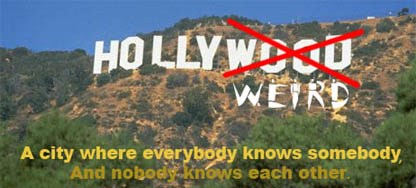
HollyWeb (or is it HollyWeird?)


I spent a week in Los Angeles in mid April and, even having spent time there in past lives (I was head of technology for Paramount Digital Entertainment for a couple of years.. a division of Paramount Television), it still strikes me as just, well, weird.

Clearly the entertainment capital of the world see's the web as a new distribution mechanism for it's content. It's also just as clear that they really don't know quite what to do with it.

It's an old story, really. How do we maintain control of our current money machine and gain control of the thing that (could) replace us? Or, at the very least, siphon off a significant portion of our revenue and a large portion of our most favored demographic?

I had my memories of Hollywood refreshed for me by a fellow I met (we’ll call him ‘Lenny’) who was represented as a high powered Hollywood agent type. There are million guys like this in Hollywood. They claim to be people that ‘know people’ and can get you the ‘deal’ you need to be ‘really big’.

What’s interesting about this is the stereotype of a Hollywood agent. The fast talking, high energy schmoozer that leaves you feeling, just a little bit, like you need a shower after spending time with them. This guy could have played the part in a movie. I liked him, but I felt, somehow, guilty about it after the fact.


He pulls up in his Jag. He’s dressed in all black (including his black snakeskin shoes). He’s got a full head of blond hair, and looks about 45 (I’m informed he’s closer to 60, but hey.. this IS Hollyweird, and it’s amazing what a little Botox can do for you).

I get the two handed handshake (takes my hand in both of his) and a warm smile. We’re scheduled for ‘an hour or so’ to talk.

I get about 30 minutes of background from him. Very connected, knows everyone. I’ve also got an idea of his net worth and how much he makes within 10 minutes. This, apparently, is part of the ‘impress the pale white geek from the internet world’ spiel. I’ve also got an idea of what models and actresses he’s slept with or lived with by 20 minutes in. this is the ‘male bonding’ part, or so I assume.

Now that his contact, financial and sexual prowess credentials are firmly established (remember, this is my first in person meeting with the guy, although I’ve had one conference call conversation with him and some others) he asks what we’re about.

Interestingly, he gets it. Sort of. He doesn’t get the user generation content piece of what we’re doing with ClickCaster, the most important part, but he gets that this is audio and video distribution with built in subscription. “kind of like subscribing to cable eh?’ Yea.. that’s it. Sort of (well, not really, but why complicate it early on).

We then go on a tour of what we can do and I find out, he’s actually actually somewhat versed in the online world. Seems he started and ran streaming content businesses in the late 90’s, early 2000’s. He’d shut it down in 2003 due to high bandwidth costs and not enough business. “My timing was bad on that one, could sell it for $300 mil if I had it today”. Maybe. But he DOES get some of what’s happening out there.

We’ve now passed three hours. He says ‘we need to talk to Mr. Big at Large Well Known Television Network'…. I look at him somewhat askance (like: uh huh.. sure we do) and he picks up on my doubt and decides he’s going to prove it. “It’s Passover” (it was) “but I’ll get him”. He proceeds to pull out two cell phones. Both advanced MS CE handsets. “I keep all 7800 of my contacts in these phones” he tells me.

He then proceeds to call Mr. Big at Large Well Known Television Network, get’s voicemail, and leaves a message something along these lines:

“Hey Larry (not his real name), Is Me, Lenny. I’ve got a guy here with Clickercast… (I correct him) I mean, ClickCaster… and this is hot babe, hot. You’ve got to see this. Worth half a billion in business bubby (I kid you not.. he really said babe and bubby, several times).

So far, I’m not overly impressed. Mostly because I have Bill Gates and Steve Jobs phone numbers and I could call and leave a voice message if I wanted to as well. Do they know me? Sort of. I’ve met them. But I doubt they remember me at all (and some assistant would screen it out).

After calling and leaving messages with three different Mr Bigs, he stops and smiles. Then a weird thing happens.

His phone rings. And damned if it isn’t Mr. Big from that Really Big Television Network. Head of programming. For real (I happen to know who the guy is by reputation). He tells him the same thing he just left as a message on voicemail and says “I got the guy right here” and hands me the phone.

Well, ok then.

We talk for a few minutes, Mr. Big asks me some questions (safe generalized ones) but not very in-depth (he doesn’t really understand, but he’d like to) and I hand the phone back to Lenny. They do the babe/bubby thing for a couple more minutes and it’s done.

“He wants to meet in NY. Next couple of weeks”. Huh.. how about that.

I say we can do that. Then the Hollywood thing kicks in. Lenny says “here’s what I need… I need (names a five figure monthly figure) , and I want (names a double digit percentage) of all money’s you get from any deals for a year and I want (names a high single digit percentage) of your companies equity.

Well sh*t.

The chasm between high tech startup and Hollywood peeks over the edge of the cliff.

To him, this is a normal deal. It’s how he works.

The calls repeat 2 more times (yea.. the other Mr. Bigs called him back within an hour or so as well). Damn, this guy really is connected.

Our hour or so meeting is now running about 5 hours with no sign of ending. He’s in full on sales mode and pushing to get me to sign up with him, right now, right here. Go! He's trying to wear me down (and it's starting to work). I'm beginning to think it's time to end this particular meeting.

I defer. Not that I don’t want the deals (although there’s some minor trepidation about dealing with Hollywood and the big media world on my part, mostly due to my experience the last time around and my memory of feeling like I was getting in a shark tank every day at work). I tell him I need to talk with my team and advisors. He keeps pushing and, finally, realizes I’m not going to agree to his terms on the spot. So he backs off. A little.

We’re now entering 7 hours of this. Dinner time, another meeting with a producer and my host. We say our goodbyes to Lenny. Even my host, who knows and works with the guy, says he's sorry for the exceeding long day, high compensation he was looking for and the hard sell.

On the way to dinner, Lenny calls me on my cell phone and he’s sitting with a fellow who has a website focused on getting unsigned bands up on the internet. The guy is an entertainment lawyer by day, band promoter - sort of (via the web) by night. “You two should merge your companies” is the first thing he says. Yea.. ok.. we'll look at that (it sort of died on the vine).

I’ve gotta give him one thing- things happens around Lenny. Or, at least he knows how to get them started.

Unfortunately, being the self funded Web 2.0 startup that we are, we just couldn’t afford him. And the percentage of equity he required was just too much for the team to buy into so we passed on working with him.

We tried negotiating with him on his terms, but I suspect he was thinking in 1999 dot.com bubble terms where startups had millions to spend without much direction on how to spend it. Not so in today’s world (and even more not so with us. We’re being extremely fiscally responsible and building what we can afford to as we go along).

He wouldn’t budge on terms, so, sadly, we had to let it go and part ways.

My gut tells me it’s a good thing though. Getting sucked into the whole ego/money/sex/speed scene of Hollywood is hard to ignore, and many DO get sucked in, but most get chewed up and spit out. It really is a big machine that’s organically configured itself to find opportunities, wring out every possible cent, then throw out the husk.

I don't know if we missed a bullet or a blessing. Time will tell, but I feel fine about the decisions we made. I'm also glad I went back to LA for a few days and steeped myself in that culture again to remind myself of why we're actually doing this startup.

It's largely about ending the kind of business Hollywood has fostered. Instead of a few large companies controlling the content you see on TV and other old media, spoon feeding you the lowest common denominator of content possible to reach the largest possible audience (and maximizing their revenue), we're about creating the next network. One that's largely powered by the people that use it.

That's, afterall, what Web 2.0 is all about. Us, the users, leveraging the collective wisdom of crowds and making it available to all of us.



Wednesday, April 26, 2006

The New Media Legal World: Not worth livin in?


I have one word for this: AAAAAAAAAAAAAARRRRRRRRRRRRGGGGG

CNET’s Declan McCullough has the scoop on a new bill backed by the Bush Administration and about to be introduced by Rep. Lamar Smith (R-TX) that will greatly expand the digital copyright restrictions in the DMCA (Digital Millenium Copyright Act). Moreover, the draft legislation, the Intellectual Property Protection Act of 2006, will also expand federal police wiretapping and enforcement powers.

McCullough says the bill goes to great lengths to expand the punishable acts of copyright infringement. For example, attempted copyright infringement would become a federal crime punishable by up to ten years in prison.

Even worse, the bill would expand section 1201 of the DMCA that bars trafficking in or distributing software capable of bypassing DRM systems to make it a crime to “make, import, export, obtain control of, or possess” such software. The legislation would also permit wiretaps in cases involving copyright infringement, boost the jail time for copyright infringement, create a new unit in the FBI for investigating copyright crimes and, most problematic of all, permit copyright holders to impound “records documenting the manufacture, sale or receipt of items involved in” infringements.

And it get's worse. From The Inquirer (http://www.theinquirer.net/?article=31256)

Piracy worse than child pornography

Society's new perspectives

By Nick Farrell: Wednesday 26 April 2006, 06:44

THE NEW look Digital Millenium Copyright Act (DMCA) seems to be giving the world an unusual moral code.

Details of the upgraded act, which has the blessing of the music and film industry and the Bush administration, are now coming to light. It appears that the DMCA will have a maximum sentence of ten years inside for the crime of software and music piracy. It will also give the FBI the powers to wiretap suspected pirates.

Although sentencing varies in the US, the new law does send a very strange message as to what the government considers 'bad' in the 21st century.

For example assaulting a police officer will get you five years, downloading child porn will get you seven years, assaulting without a weapon will get you ten years and aggravated assault six years.

So in other words if you copy a Disney CD and sell it you will be in the same league as a paedophile who is distributing pictures of sexual attacks on children.

If you copy Craig David's CD you get ten years, but if you punch him in the face and pummel him into a seven day coma you will only get six. You are more likely to get the respect of the prison population with your six year sentence as well.

Like I said: AAAARRRRRRRGGGGG

I have no problem with protecting intellectual property. That's a good thing. What I do have a problem with is giving a federal government that doesn't have much of a track record on applying laws in the interest of we, the people, in an overly fair and well thought out way yet more power to enforce much of anything. These guys have been showing us that they think having a little means they think they can take alot. At this point, at least for me, it's a trust issue. Can we honestly trust our federal government with powers like this? Based on the last few years, I'd say: not likely.

Saturday, April 22, 2006

A high school teacher's experiment in fascism


Click on the title above (or cut and paste this into your browser):

http://www.vaniercollege.qc.ca/Auxiliary/Psychology/Frank/Thirdwave.html

Read it all. Don't wimp out. Ask yourself: can this happen again? Ask yourself: do our political leaders use tactics like this today? Even a little? Just a enough to bend things and create, at least in shadow form, some of what the world experienced in the late 1930's and 1940's? You know.. 'just a little'?

Friday, April 21, 2006

China and the startup world

This is an interesting one.

My company is in the process of working through the creation of a company in China as a partnership with a Chinese company and a European company. China brings, well, China, among other things (like high level government contacts, licenses to do business in China, localized knowledge, distribution, etc); the EuroCo brings cellular technology for OTA (Over The Air) type digital content delivery and we (ClickCaster) bring the content/delivery platform.

Intriguingly, what seems to make this venture so interesting to everyone involved is the fact that an American internet startup is involved. It seems to have a sort of cache that is getting people's attention (from government and industry to investors in Asia).

We're working with a very high energy women who is an executive of the Chinese company and would be at home in a fast paced American company (she speaks perfect American English with just a faint twinge of English accent periodically creeping in) and she's got honest to god vision.

Now, having working in China before in my Motorola days, this is more than a little unusual. And she honestly gets what the whole user generated media world is about. During one of our regular weekly progress calls (currently we’re co-writing the overall business plan), I brought up the potential of bringing in the US Television folks (I recently spent a week in LA with some true Hollywood types- I’ll blog about that one in the near future) and the initial response was 'well, we could do that, but why? This is about replacing the old media'.

Well, damn. She sounds like she lives in Boulder or Silicon Valley and like she's the CEO of a small user generated social networking focused software startup company we know and love! (yea.. us). Heh. Whodathunkit.

More on this as it develops. Compared to my past China business experiences, this is more than just refreshing, it's downright exciting.

Tuesday, April 18, 2006

The personal economics of blogging

I haven't really thought a lot about this until just recently, but what are the personal economics involved with blogging?

By personal economics, I mean the cost, and the payoff, to the blogger of fulfilling the need to write what amounts to a personal journal that the entire world can see real-time.

I know many of us think we have a lot to say. That we're somehow unique in our point of view. That we have some specialized set of knowledge worth sharing. And some of us use it as a way of expressing our creativity, or our angst and anger at the world.

I know bloggers that share knowledge of their industry that's invaluable to their readers. There's a fellow here in Boulder (Brad Feld at www.feld.com) who's a Venture Capitalist and who writes about the VC world, and his life in general, regularly. The knowledge he imparts, at least to a specific audience, is literally invaluable. He also shares some of his passions. He is a marathon runner and is running in the Boston Marathon this year. He was invited to do this because of charity work he did for an associated to the BM charity, and, well, he's a marathoner.

I know he was very happy to have this opportunity (not everyone get's to run that marathon) but when he blogged about it, one of his readers sent a scathing letter belittling his 'buying his way in' to this rather elite runners event. He posted some of it (with a thoughtful and measured reply). What this person wrote was more than hurtful. It was bordering on vicious.

By his reply it was obvious that he was taken aback. This was a special event for him. Something he'd worked toward (in ways he's particularly gifted at) and rewarded for. And he shared that goodness with his readers only to be lambasted and ridiculed.

Many would hang up the blog after something like that. He, of course, took it in stride, but it had to hurt.

We share our experiences and, in some ways, we teach using blogs. We teach about things we've learned in live. We impart knowledge and experiences. And we're, often, rewarded by our readers with notes of thanks and encouragement. But we pay a price as well. We open ourselves up to attack from people we often don't even know (but who feel they know us because they read our blogs regularly, and take a little tiny piece of our minds with them).

When someone like Brad who's blogging truly adds back to the world has something like this happen, you have to wonder if the price is worth it.

In a limited way, I suppose it's a little like becoming a celebrity to a very specific audience. He has several thousand regular readers who know him pretty intimately through his blog. Many, I'm sure, feel he's their 'friend'. It really is in a (very small) way like being a movie star. People feel they can say things to you (because of what, to them, is intimate familiarity) they would never say to someone they'd never met before.

As with most things, it's a two edged sword. The good (kudo's encouragement and thanks for your insights and observations) countered by the unbalanced and irrational attacks of someone who, I would guess, couldn't get into the Boston Marathon and was pissed off Brad did, so attacked. Hard.

It does make you wonder though. It is worth it? Maybe it's a 'that's life' thing, but it never ceases to amaze me how people can take the good someone does and turn it into pain.

I doubt it will change Brad's blogging much. But I would bet it'll change what he writes about to some degree. And I'd also bet that he'll think more about what he puts in his blog and the reaction they may or may not evoke (at least for awhile).

The personal economics of this? You’d have to ask Brad, but there’s most definitely a cost.


Meta’s AI Gamble: Hype or Hubris?

  Meta’s AI Gamble: Hype or Hubris? Meta’s latest earnings call was a masterclass in optimism, with their leadership painting a rosy pictur...